


Back to Solutions

Talent Science™

Turning workforce architecture into competitive advantage

Talent Science™ is the first quantitative and predictive workforce measurement platform designed specifically for life sciences.

Unlike traditional HR metrics that describe the past, Talent Science™ uses real data to predict capability, performance, and risk months before issues appear. It is a unique framework that treats workforce behaviour as a measurable system, allowing organisations to forecast productivity, prevent bottlenecks and link people decisions directly to financial outcomes.

No consultants on site, no disruption to your daily operations
Predicts capability, performance and risk, months before issues surface
Backed by our Advisory Board, ensuring our solutions are shaped by our clients

The product ecosystem

Talent Science™ is a first-of-its-kind predictive workforce platform, helping you quantify what others guess at.

Execution Capability Model

Execution capability for growth-stage companies.

AI and Digitalisation

Designing the workforce of the future.

Launch Readiness

Go-to-market (GTM) and execution optimisation.

Enterprise

Strategic workforce engineering.

Workforce Due Diligence

Predictive workforce architecture due diligence.

Predictive GxP Intelligence

Predicting deviations before they happen.

How it works

Operational Inputs

  1. Workforce
  2. Strategy
  3. Financial

Talent Science™ Modelling

  1. Data conversion
  2. Workforce architecture analytics
  3. Predictive scenario simulations

Outputs

  1. Executive dashboard and report
  2. Predictive strategic recommendations
  3. Financial upside and risk analysis

Our latest Talent Science™ customer stories
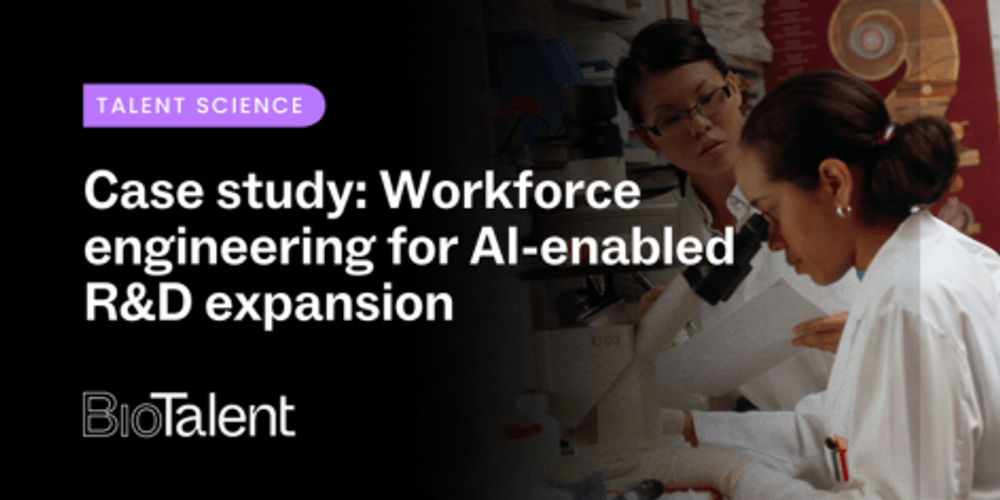
Case study: Workforce engineering for AI-enabled R&D expansion

Case study: Workforce engineering for AI-enabled R&D expansion

KEY OUTCOME

Client overview

Our client, a global pharmaceutical organisation, was undertaking a multi-site expansion of its AI-enabled and digitally integrated R&D capabilities, spanning discovery, development and translational science. The programme aimed to accelerate innovation velocity while maintaining regulatory precision, data integrity and global consistency across sites.

The challenge

The organisation faced several interrelated workforce and execution challenges during R&D site expansion. These included:

  • Risk of mis-hiring frontier digital roles before platform and operating models were fully mature
  • Potential loss of critical institutional and regulatory knowledge during transformation
  • Uneven capability readiness across sites as AI and digital systems scaled
  • Limited visibility into which roles should be retained, retrained, recruited or automated
  • Growing execution risk as workforce complexity increased faster than headcount

Company leadership required a systematic, evidence-based framework to align talent decisions with digital ambition and site-level execution realities.

Our solution

BioTalent applied a Talent Science™ workforce blueprint, using the Retain, Retrain, Recruit, Automate (4R) framework across 2,000 R&D employees. This allowed our client to:

Segment roles by urgency, automation feasibility, skills adjacency and attrition risk

  • Identify which roles needed to be retained, due to high knowledge density and regulatory dependency
  • Target retraining pathways for adjacent roles transitioning into AI-enabled workflows
  • Create precise recruitment profiles for capabilities that couldn’t feasibly be developed quickly internally
  • Select automation road-mapping for repeatable, rules-based R&D activities

The Talent Science™ framework was aligned to platform maturity and site ramp-up timelines, ensuring workforce actions supported execution rather than disrupting it.

The results

  • Clear prioritisation of retain vs retrain vs recruit vs automate decisions at enterprise scale
  • Reduced risk of capability loss during AI and digital transformation
  • Faster time-to-productivity for new and expanding R&D sites
  • Avoidance of premature or misaligned external hiring
  • Measurable reduction in workforce-driven execution risk across digital programmes

The approach enabled our client to scale digital R&D capability without inflating headcount or destabilising delivery.

Why it worked

  • Systematic role classification: decisions based on execution dependency, not job titles
  • Skills adjacency logic: retraining focused where transition probability was highest
  • Automation discipline: applied where risk and feasibility thresholds were met
  • Platform synchrony: workforce actions sequenced to digital system maturity
  • Enterprise visibility: leadership gained a unified view of workforce readiness across sites

Ready to turn your workforce into a strategic asset?

Contact us below to learn how BioTalent can help you access the insights that can turn talent from constraint to competitive advantage.

Employer insights
Case study: Predictive knowledge agility in a global CMC pathway

Case study: Predictive knowledge agility in a global CMC pathway

KEY OUTCOME

Client overview

Our client is a major global pharmaceutical organisation operating complex, multi-site chemistry, manufacturing and controls (CMC) pathways. The organisation sought to improve cycle-time predictability, inspection readiness and execution stability within a priority manufacturing and regulatory pathway. Significant investments had been made in digital systems and process standardisation, yet our client continued to experience hidden friction, rework and escalation load.

CMC leadership required a way to move beyond descriptive KPIs and retrospective deviation analysis toward a predictive, inspection-defensible control system for knowledge flow and pathway performance.

The challenge

Despite stable headcount and established quality systems, the organisation faced persistent operational challenges, including:

  • Unexplained variability in cycle-time across similar submissions and batches
  • Escalating dependency on a small number of SMEs to resolve interpretation gaps
  • Rework loops and approval delays emerging late in the pathway
  • Limited visibility into how knowledge degraded or queued across hand-offs
  • Difficulty justifying further digitalisation, training or automation investment without quantified impact

Traditional metrics failed to explain why delays occurred or where intervention would have the greatest effect.

Our solution

BioTalent applied a Talent Science™ knowledge agility framework to instrument the selected CMC pathway using workflow metadata only. The pilot established a predictive, finance-grade model linking knowledge flow behaviour to execution outcomes.

  • Quantitative mapping of knowledge movement, queueing and degradation across the pathway
  • Identification of tacit bottlenecks, interpretation variance and rework loops
  • Construction of a KAI-F execution-health score (0–100) representing pathway stability
  • Predictive modelling of cycle-time, labour and compliance deltas under alternative interventions
  • A financial impact model to support defensible investment and scale-up decisions

All analytics were aligned to ICH Q10, Annex 11/15, and ALCOA+ principles, ensuring inspection defensibility.

The results

  • Clear identification of hidden friction points driving cycle-time variability
  • Early warning of execution instability before delays materialised in submissions
  • Measurable reduction in SME escalation load and interpretation dependency
  • Improved approval velocity without structural reorganisation
  • A reusable, pathway-level control system rather than a one-off assessment

Leadership gained visibility into how knowledge behaviour directly influenced performance, enabling targeted intervention rather than broad remediation.

Why it worked

  • Predictive, not retrospective: risks were surfaced before cycle-time impact occurred
  • Metadata-only approach: zero disruption to validated systems and workflows
  • Regulatory alignment: outputs were inspection-defensible by design
  • Financial translation: knowledge friction was quantified in cost and delay terms
  • Reusability: the KAI-F architecture could be scaled across pathways and sites

Ready to turn your workforce into a strategic asset?

Get in touch below to learn how BioTalent can help you access the insights that can turn talent from constraint to competitive advantage.

Employer insights

Your Talent Science™ team

Our experts are here to help you every step of the way on your talent analytics journey.

Vice President of Talent Science™ & Thought Leadership

CEO & Founder
News and views in Talent Science™

Follow the latest thinking on workforce architecture, execution risk and predictive modelling in life sciences, from the team behind Talent Science™.

Sign up to our newsletter

Ready to transform your workforce?

Contact us to arrange a discovery meeting to find out how Talent Science™ can help your organisation